
Work with us to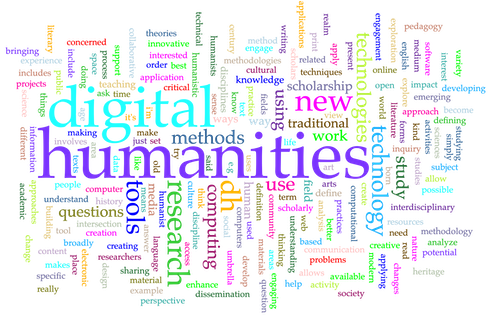
- plan, sustain, & preserve collaborative digital projects
- identify suitable methods & platforms
- build & analyze collections of humanistic data
- address ethical concerns about accessibility, collaboration, technology, & impact
Get started | Schedule a consult | Subscribe to our Newsletter | Attend a workshop | Learn about projects
Upcoming Workshops
Digital Humanities: A Gentle Introduction
This workshop offers graduate students and faculty a gentle introduction to the theories, ethical concerns, and methods of digital humanities (dh) and provides resources for future learning and engagement. We will consider the theories and methods that make up dh, reasons why scholars might pursue dh research and/or pedagogy, and various modes of participation. Participants will engage with case studies that consider key dh principles and practices such as data feminism, multilingualism, minimal computing, text analysis, visualization, and storytelling. Building on these examples, they will engage in a project planning activity that introduces key considerations for designing a dh project.
By the end of this workshop, participants will be able to
- describe what digital humanities means to them;
- explain why and how they might or might not integrate dh into their research and/or teaching;
- articulate key considerations for designing a dh project; and
- identify and access dh resources at Duke and beyond.
This workshop will be facilitated by Hannah Jacobs, Digital Humanities Consultant with Duke Libraries.
Priority will be given to faculty & graduate students in the arts, humanities, and interpretive social sciences.
Location: Music Library Seminar Room, Biddle Music Building, East Campus
Participation: General discussion, structured activity, and time for questions.
Digital Humanities: A Gentle Introduction
This workshop offers graduate students and faculty a gentle introduction to the theories, ethical concerns, and methods of digital humanities (dh) and provides resources for future learning and engagement. We will consider the theories and methods that make up dh, reasons why scholars might pursue dh research and/or pedagogy, and various modes of participation. Participants will engage with case studies that consider key dh principles and practices such as data feminism, multilingualism, minimal computing, text analysis, visualization, and storytelling. Building on these examples, they will engage in a project planning activity that introduces key considerations for designing a dh project.
By the end of this workshop, participants will be able to
- describe what digital humanities means to them;
- explain why and how they might or might not integrate dh into their research and/or teaching;
- articulate key considerations for designing a dh project; and
- identify and access dh resources at Duke and beyond.
This workshop will be facilitated by Hannah Jacobs, Digital Humanities Consultant with Duke Libraries.
Priority will be given to faculty & graduate students in the arts, humanities, and interpretive social sciences.
Location: Murthy Digital Studio (Rm 121), Bostock Library, West Campus
Participation: General discussion, structured activity, and time for questions.
Digital Project Planning
Working collaboratively and/or producing digital scholarship have become common practices across academia. Project planning skills are valuable especially in these contexts and for researchers at any stage in their career.
This workshop, appealing to graduate students and faculty across disciplines but especially in the arts, humanities, and interpretive social sciences, introduces key concepts in project management and how they can be applied effectively in collaborative and digital scholarship. A project planning activity and discussion will enable participants to appreciate the value of project planning; begin formulating their own strategies for project management; and offer a toolkit of ideas and approaches. To support the activities, participants are encouraged to bring a project idea to the workshop.
By the end of this workshop, participants will be able to
- articulate how goals, people, resources, and dissemination and maintenance plans interact to form and influence project scope;
- identify factors to consider when evaluating project resources and possible goals; and
- develop their own project plan using a provided template.
This workshop will be facilitated by Hannah Jacobs, Digital Humanities Consultant with Duke Libraries.
Location: Murthy Digital Studio (Rm 121), Bostock Library, West Campus
Participation: Individual activity, small and large group discussions will be a significant part of this workshop.
Digital Project Planning
Working collaboratively and/or producing digital scholarship have become common practices across academia. Project planning skills are valuable especially in these contexts and for researchers at any stage in their career.
This workshop, appealing to graduate students and faculty across disciplines but especially in the arts, humanities, and interpretive social sciences, introduces key concepts in project management and how they can be applied effectively in collaborative and digital scholarship. A project planning activity and discussion will enable participants to appreciate the value of project planning; begin formulating their own strategies for project management; and offer a toolkit of ideas and approaches. To support the activities, participants are encouraged to bring a project idea to the workshop.
By the end of this workshop, participants will be able to
- articulate how goals, people, resources, and dissemination and maintenance plans interact to form and influence project scope;
- identify factors to consider when evaluating project resources and possible goals; and
- develop their own project plan using a provided template.
This workshop will be facilitated by Hannah Jacobs, Digital Humanities Consultant with Duke Libraries.
Location: Music Library Seminar Room, Biddle Music Building, East Campus
Participation: Individual activity, small and large group discussions will be a significant part of this workshop.
Humanities Research and AI
How can humanities scholars and students engage with and/or critique AI responsibly and effectively in their research?
This workshop will review basic concepts related generative artificial intelligence; highlight major policy and ethical concerns; and provide guidance grounded in existing policies with regard to AI use across research practices—from initial research to analysis, publication, and peer review. Discussion and an activity will offer participants space to investigate the possibilities and limitations for AI in their work.
By the end of this workshop, participants will be able to
- explain in general terms what generative AI is;
- describe major concerns for its integration into humanities scholarship;
- identify opportunities and challenges of applying and critique AI in research.
This workshop will be facilitated by Hannah Jacobs, Digital Humanities Consultant with Duke Libraries.
Priority will be given to faculty & graduate students in the arts, humanities, and interpretive social sciences.
Location: Music Library Seminar Room, Biddle Music Building, East Campus
Participation: General discussion, structured activity, and time for questions.
About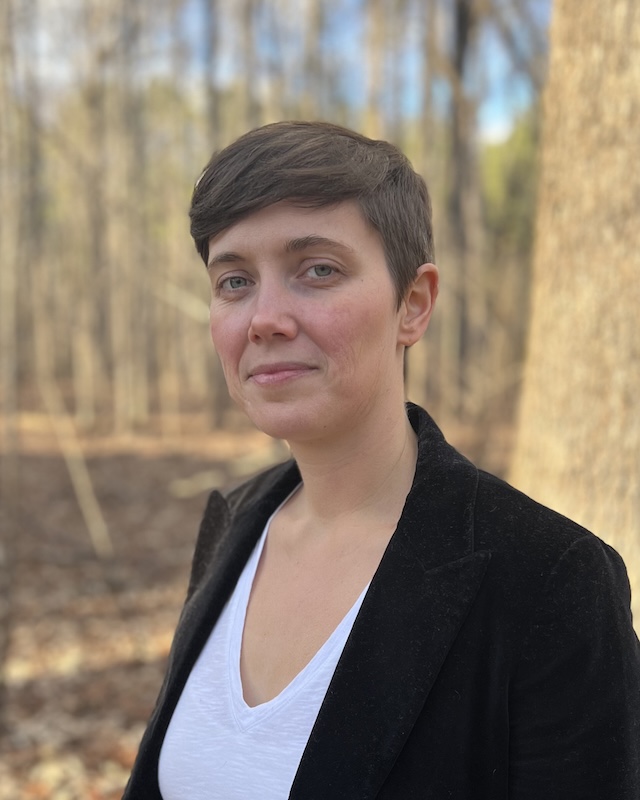
Hannah L. Jacobs is Duke Libraries’ Digital Humanities Consultant. She consults and collaborates with staff, students, and faculty on digital humanities topics broadly. She also connects humanities researchers with and advocates for technological resources on campus. She offers consultations on digital project planning and building, as well as best practices for a wide range of technologically-engaged research. She also offers instruction in a broad range of digital humanities topics and can work with researchers, instructors, and units to design area-specific workshops.