
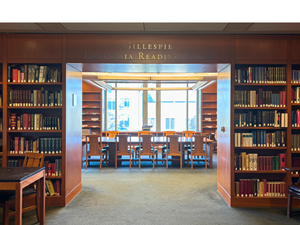
The East Asian Collection at Duke University Libraries consists of modern and contemporary materials in Japanese, Chinese, and Korean, with a focus on the humanities and social sciences. The collection traces its origins to the late 1920s, when James A. Thomas (1862–1940)—a businessman who spent over 30 years in China managing operations for the British-American Tobacco Company—donated 1,500 volumes from his personal library to Duke University. Expansion began in the late 1960s with the acquisition of Japanese materials, followed by Chinese and Korean materials in the 1990s. Today, the East Asian Collection serves as a regional resource center supporting students and researchers across disciplines.
The Chinese Collection
The Chinese Collection emphasizes modern and contemporary history, social studies, media studies, demography, politics, literature and Buddhist arts. In the 1990s, Duke revised its cooperative agreement with the University of North Carolina at Chapel Hill (UNC), which had traditionally specialized in Chinese history, literature, and religion. This strategic shift allowed Duke to build complementary strengths in areas such as popular culture and contemporary social sciences, broadening the scope of Chinese studies and enhancing regional research resources.

The Chinese unique collection focuses on two themes: perceptions of China through Western eyes from late Qing to the Republic era and the early history of People’s Republic of China (1949-1979). The first includes works by missionaries, businessmen, diplomats, scholars, and soldiers who visited China and produced photographs, diaries, films, letters - for example, the Sidney Gamble Photographs. The second features propaganda materials documenting key political movements in the PRC’s first three decades, such as 1950s anti-Americanism, the Great Famine, and the Cultural Revolution; a notable example is the Memory Project.
The Japanese Collection
Duke University has the largest Japanese collection south of the Library of Congress in Washington, D.C. It is strong in early modern, modern, and contemporary histories, with emphasis on colonial and postwar periods. It also offers comprehensive coverage of topics in visual and media studies, gender and sexuality, religion, political science, and literature.
The Japanese Collection draws regional, national, and global scholars to Duke for research. Significant sub-collections include prefectural histories, art exhibition catalogs, postwar studies, newspapers, women’s periodicals, and archival works related to contemporary Zen Buddhism, natural disaster, postwar medical histories, and student movements.
The Korean Collection
The Korean collection focuses on contemporary Korean society and culture, and colonial experience. The collection covers a wide range of subjects in the social sciences and humanities with strengths in history, literature, art history, Buddhism, colonial literature and history, film and performing arts, and Linguistics and language teaching materials.
The Korean unique collection has key primary sources from during the periods of Japanese occupation and the Korean War, including , photographs, postcards, and papers, missionary works, visual ephemera, diaries, posters, letters, reports, and military manuscripts from the war period, as well as robust digital collections of postcards from the colonial period.