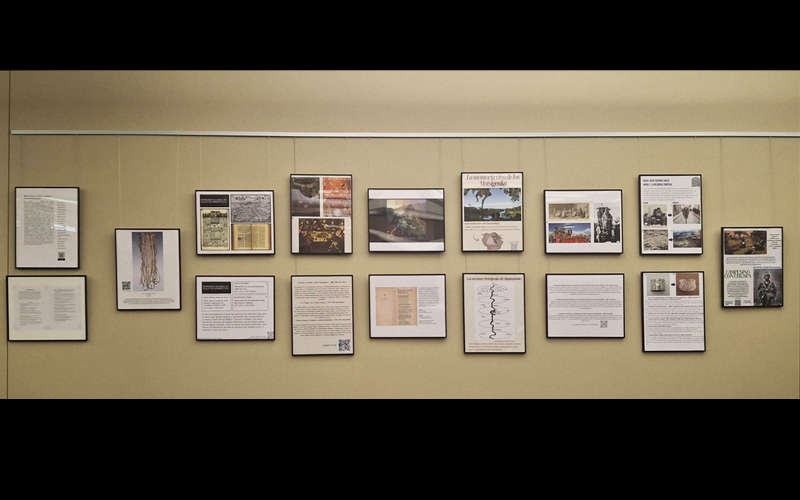
This exhibition is the result of collaborative readings, conversations, and research in our class, Cuzco: Local e Imperial (SPAN 425). We explored the relation among images, living culture, and the written history of Cuzco. The exhibition invites you to contemplate Cusco as a city where Andean and Amazonian communities have, for centuries, created the vital force of territorial memory. Images of the past and present reveal how tourism transforms landscapes and urban dynamics, and, at the same time, how Andean practices sustain daily life with resilience. The exhibition presents the diversity of art and writing produced during the colonial period, as well as textiles and ancestral Indigenous material culture. The contributions of Felipe Guaman Poma de Ayala, Inca Garcilaso de la Vega, Martín Chambi, and Callañaupa show how, throughout the centuries, perspectives and ways of narrating and illustrating imperial and local history in Cusco have been reformulated. The Matsigenka presence broadens this horizon to the Amazon, reminding us that the region is profoundly multilingual and multiethnic. The textiles of Chinchero and the Inti Raymi ceremonies evoke the ritual continuity that spans generations. Likewise, from the dialogue between the wiphala, Chambi's lighting, and Neruda's poetry, colors and stones emerge that connect us to the spiritual continuity of the Andean world through diSerent artistic forms. Finally, the syncretism and hybridity of colonial painting demonstrate the capacity of Andean peoples to transform and create even in a context of imposition.
Alicia Martinez, David Clements, Abigail DiSalvo, Lourdes Dubose, Nathan Gaviser, Maddie Goldner, Rohan Guddanti, Lauren Ingram, Tom Lowrance, Ana Martinez, Aidan McCarthy, Luke Mergott, Isabella Moreno, Nestor Nshimiye, Uriel Nascimento, Santos Pinho, Angelica Serna Jeri, Natasha Singh, Eloise Warfel, Maddie Weiler, Larkin Woodard