Our commitment to privacy
The Duke University Libraries recognize the importance of protecting your privacy and the confidentiality of the information you share with us when you use our websites, spaces, and services. This page describes our practices for collecting, disclosing, maintaining, protecting, and using your personal information.
Duke Libraries Privacy Bill of Rights
- You have the right to know what data we collect and how we use it. We commit to keeping this page updated with that information.
- We hold ourselves accountable to professional standards and institutional and legal requirements, including: the Duke University Privacy Statement, the Code of Ethics of the American Library Association, the Stanford Libraries statement on patron privacy and database access, and state and federal laws.
- Across all of our systems, we try to limit collecting or retaining any data that will connect you to specific resources. We especially protect these data from being shared with third parties, unless required by law.
- We choose our third-party tools as carefully as possible to align with our privacy goals. Library staff can also offer advice on how to protect your data when working with other tools.
- We value user choice in data collection. You may opt out of being tracked as you navigate our websites.
- Data can help us understand our users’ needs, when gathered responsibly. We commit to limiting data collection to the specific data we need for security or assessment purposes and to improve services based on what we find in the data.
Advice on protecting your privacy
- You can use third-party extensions to customize privacy settings for your web browser (see extensions for Chrome or extensions for Firefox).
Information we collect
- The Libraries use an open source privacy-focused web analytics platform called Matomo to help us generally understand how people use the Libraries’ websites and to make improvements to our services. We run this service on Duke infrastructure so we have full ownership and control over the data. It is not shared with third parties.
- We use Matomo in a manner that is compliant with the European Union’s General Data Protection Regulation (GDPR) and related privacy laws. Our setup uses cookieless tracking, data anonymization, and other privacy measures.
- Matomo supports your web browser’s “Do Not Track” preference settings.
- Library accounts maintain personally identifiable information that enable you to check out library resources, borrow items from other institutions, and view online articles, journals, and databases that are licensed through the Libraries.
- We maintain the confidentiality of information in library accounts and do not make this information available to any entity outside the Libraries, except as required by law or appropriate law enforcement procedures.
- You are entitled to view your library account information.
- The DukeCard system stores data each time Duke faculty, staff, students, or sponsored guests swipe into a space that requires card access; this includes specialized spaces with restricted access (e.g., the Doctoral Research Space) or general building access at certain times of the day.
- Please be advised, we have security cameras located throughout the libraries. When necessary, authorized library staff review footage to address security concerns.
- The Libraries collect and store personal information that you submit when using our web-based tools such as chat, web form, email, room reservation, event registration, and payment systems.
- We use your personal information for the purpose for which you submitted it, and we occasionally invite you to provide optional feedback on your experience using these library services.
- Web-based applications supported by the Libraries log technical information from your web browser about application usage.
- We use these application logs for security purposes and when diagnosing problems such as website outages.
- The Libraries use web browser session cookies to maintain user preferences for features such as the saved items folder in the Books and Media Catalog and the default search scope on the Library homepage. These cookies are only created if you opt to use these features and will be eliminated when you clear cookies from your browser.
- We also use cookies to limit the adverse impact that AI harvesting bots have on library sites. We are using a tool called Anubis to block bots on these sites, and this tool places a cookie on your machine to indicate you have been confirmed as a human. The cookie will remain for one week and prevent you from seeing additional challenges during that time.
- Our website contains links to third-party tools, websites, and licensed databases that are provided by external vendors.
- We always prioritize patron privacy when negotiating contracts with vendors.
- The Libraries are not responsible for the privacy practices or content of these third parties. We encourage you to read the policies associated with these third-party tools before using them.
How data helps us improve services
We keep patron privacy at the forefront in our services. At the same time, we know it’s important to stay in touch with our users and their needs. Here are some ways we use data to improve our services.
Staff analyze aggregate data about the circulation of textbooks kept on reserve at the Libraries. Understanding the extent to which textbooks for different classes are used helps us improve outreach and awareness around the textbook lending program and make decisions about how many copies of different textbooks to keep on reserve at different library locations.

The Libraries analyze aggregate, anonymous data about what materials patrons request to borrow through Duke from other universities. This Interlibrary request data helps librarians decide which new materials to purchase for our collections.

Our staff analyze swipe card data to determine whether the Doctoral Research Space is used at capacity and how many new students can be granted access to the space each semester. We can also use it to understand the frequency with which people make use of the space.

The Libraries use Matomo to track overall trends in the terms you use when searching library resources. For the 100 most common searches, staff curate a list of “Top Results” (such as PubMed), which are presented prominently when those search terms are used.

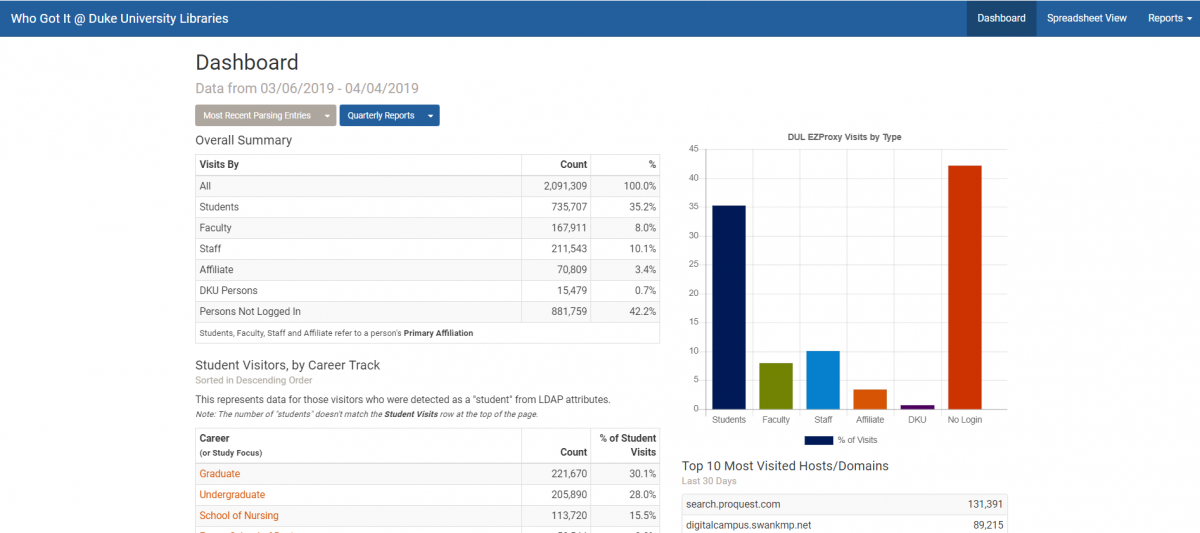
We analyze your use of the Libraries’ electronic resources. Staff use this data to better understand which resources are used, as well as how affiliates of different schools and departments are using various resources. One way this analysis helps us is in negotiating prices for resources with database vendors.